
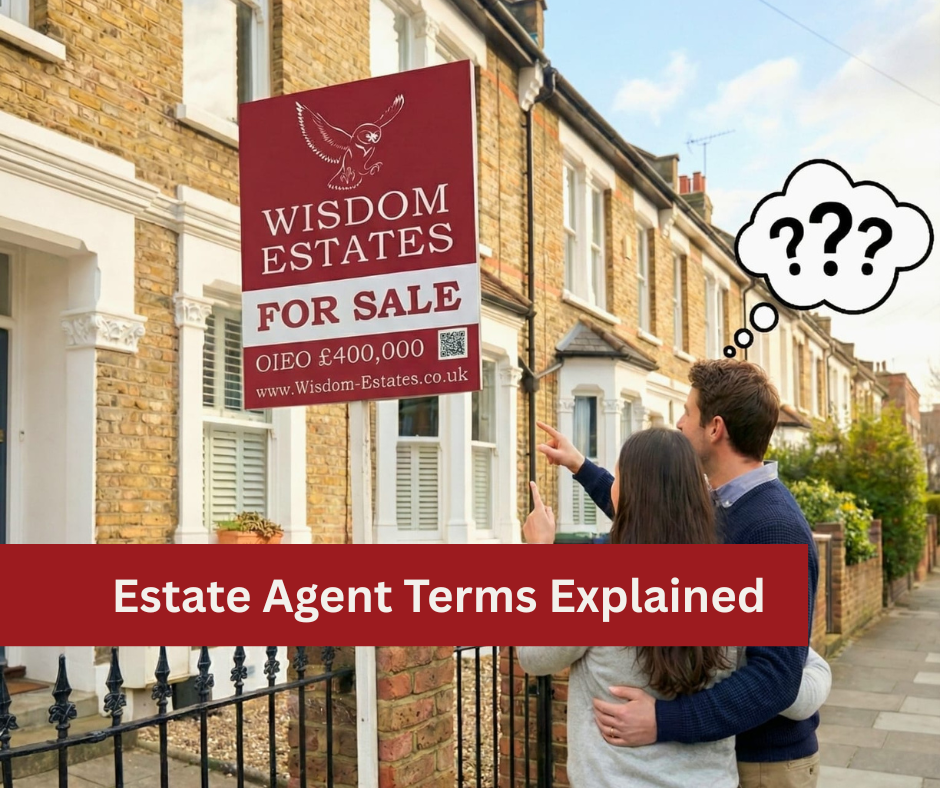
Understanding Estate Agent terms makes selling or buying a home far less daunting. These acronyms appear on many property listings, yet many buyers and sellers are unclear about what they actually mean.
Wisdom Estates have broken down the most common Estate Agent terms below, by explaining their meanings in an easy-to-understand format, and how they affect they buying and selling process.
What Does O.I.E.O Mean?
O.I.E.O. means Offers in Excess Of. Estate Agents use it when sellers are looking for offers above the quoted marketing price. For example, when a home is listed as: OIEO £400,000, the seller is setting a minimum threshold price of £400,000, and not a fixed asking price.
Sellers often choose OIEO with a view to generating strong market interest, and creating competition between buyers. A slightly lower starting figure can attract more interest on property portals, and in turn boost viewings, to encourage multiple offers.
However, many buyers are wary of OIEO because they often have a fixed budget, and this type of pricing can feel vague, but it can work well for the seller in a high-demand market.
Buyers often assume that they need to offer above the OIEO price, but this isn’t necessarily true. If the property receives low interest, sellers may still consider offers close, or even some way below, the guide price. It very much depends on market demand and timing.
What does O.I.R.O mean?
O.I,R,O. means Offers in the Region Of. This term gives buyers the most flexibility, because when sellers use OIRO, they ask buyers to submit offers more loosely around the asking price. That could mean slightly under, slightly over, or the stated price. Agents prefer this term, especially when they know the property value sits within a more variable range, or when they expect negotiation to play a major part in the sale.
For buyers, OIRO usually feels more open and less intimidating than OIEO. It actively invites conversation and negotiation and shows that the seller is open to realistic and sensible offers.
What does a Guide Price mean?
A Guide Price gives buyers an indication of what a seller hopes to achieve, and sets a realistic expectation for offers.
Sellers and their Estate Agents often use Guide Price marketing when:
• The property is unique, and more unusual factors could determine its value to potential buyers.
• The seller hopes to attract a wide range of interest on a specific ‘open day’.
• The market is buoyant, and competition could result in higher offers.
Although, broadly speaking, Guide Prices are similar to O.I.R.O they carry a slightly broader meaning. Guide Pricing effectively encourages buyers to use the price as guidance only. Offers below, can still spark a positive conversation, providing they are sensible offers.
Because portals like Rightmove & Zoopla filter results by price bands, Guide Prices help Estate Agents position a listing where it will attract maximum exposure for the seller.
Why is it a Good idea to hold an Open Day?
An open day gives buyers the chance to view a property at a set time without booking individual appointments. Estate Agents use open days to create interest, increase footfall, and encourage competition between buyers. This approach works especially well for homes in high demand, as multiple viewings in a short window can lead to quicker offers. Sellers also benefit from reduced disruption, as viewings take place in a single, organised session rather than over several days.
What does Fixed Price / Asking Price mean?
A Fixed Price (or more simply put – an Asking Price) indicates that the seller is after a definite figure for the property. In this scenario, negotiation on price can be less flexible, but it does mean that the first strong offer that meets the fixed price, often secures the sale.
Sellers choose a Fixed Price option when:
• Looking for a quicker, stress-free transaction
• They are confident of the home’s market value
• Expect strong interest from buyers in a good position
Buyers appreciate Fixed Prices because they avoid any guesswork, and the uncertainty that can unsettle buyers, when competing against offers surrounding O.I.E.O or Guide Price listings.
What does P.O.A mean?
POA means for Price On Application. In this situation, buyers would need to contact the Estate Agent to request more information. POA typically appears more frequently on premium or unique homes.
Sellers will use POA to:
• Create intrigue
• Invite buyers to initiate a conversation with the Estate Agent
• Maintain a degree of discretion in the local market
Buyers sometimes feel uneasy about POA, because it requires them initiating direct contact with the Estate Agent at the outset, to gauge the expected price, but it works well in certain markets. It shouldn’t put buyers off, as ‘the early bird often gets the worm’.
P.O.A can benefit sellers, as it allows them to judge the level of interest, without revealing the price they expect to achieve.
What does SSTC / Sold STC mean?
SSTC or STC means Sold Subject to Contract. It means that the seller has accepted an offer, but that the sale hasn’t legally completed. The property effectively pauses on the open market, while solicitors handle searches, contracts, and enquiries.
Many buyers will still express interest when a property is shown as STC, because fall-throughs can happen. For this reason, Estate Agents should will keep a list of other interested parties, at least until final completion occurs.
What do EPC, No Chain, BTL & LTV mean?
Estate Agent listings often include additional acronyms, that are designed to help buyers identify other considerations relating to the property.
• EPC: Energy Performance Certificate rating (A–G scale).
• No Chain: No Chain is an indication that the seller is not dependant on buying another property before selling.
• BTL: Buy-To-Let investment property.
• LTB: Let-To-Buy
• LTV: Loan-To-Value mortgage ratio.
What does BTL mean?
BTL means a Buy to Let Mortgage that allows investors to purchase a property specifically to rent out and generate ongoing income. Landlords rely on rental payments to cover mortgage costs while benefiting from long-term property value growth. This option appeals to those looking to build a property portfolio or secure an additional income stream, but lenders closely assess rental yield, affordability, and the investor’s financial position before approval.
What does LTB mean?
LTB means Let to Buy, which enables homeowners to rent out their current property while purchasing a new home to live in. Instead of selling, owners turn their existing home into a rental investment, often using the income to support their next purchase. This approach suits people who want flexibility when moving, but it requires careful planning, as lenders review rental income, equity levels, and overall affordability.
What does LTV mean?
LTV means, Loan to Value, this shows how much you borrow compared to the property’s value, expressed as a percentage. Lenders use LTV to assess risk and set interest rates, with lower LTVs often unlocking better mortgage deals. Buyers reduce their LTV by increasing their deposit or choosing a lower-priced property, which can improve affordability and lender confidence. Understanding LTV helps buyers plan deposits more effectively and make stronger, more informed mortgage applications.
Sellers – What's the best Pricing Term to choose?
Each pricing term shapes the strategy behind a sale:
• OIEO - Offers in excess of increases competition, and aims for the best price
• OIRO - Offers in the region of encourages negotiation with serious buyers
• Guide Price attracts a wider audience
• Fixed Price / Asking Price supports speedier, decisive sales
• POA - Price on asking enhances discretion and exclusivity.
A good Estate Agent will discuss these options with a seller, based on demand, market conditions, and the seller’s priorities.
Buyers - What's the best Tips for Navigating the various Pricing Terms?
At Wisdom Estates, we understand that buyers can feel a little overwhelmed by the jargon shown in property listings. These quick tips should help you navigate them more easily:
• Treat OIEO as a guideline, not a firm rule
• Use OIRO and Guide Price as negotiation opportunities
• Don’t shy away from POA – it never hurts to ask
• Compare current listings with similar sold properties
• Do ask the Estate Agent, if the seller will consider a lower offer
What more links to seeing your home?
If you are thinking to sell a property, you should read our related article 'Selling Your Home Guide' and you will need a Conveyancing Solicitor. Read our 'Why You Need a Conveyancing Solicitor for Buying a House' guide and it may be useful to know
Thinking of Selling in Sidcup, Bexley or Dartford?
If you want expert advice on pricing strategies – O.I.E.O, O.I.R.O, Guide Price, Fixed/Asking Price, or P.O.A - Wisdom Estates can guide you with clarity and confidence. As a proud independent Estate Agent, we have helped countless sellers choose the pricing structure that optimally showcases their property, to ensure maximum interest, and the best possible final sale price.
Wisdom Estates is a friendly and efficient team that helps homeowners achieve successful sales across Sidcup, Bexley, Dartford, and the surrounding areas.
Thinking of selling? Talk to us today:
Sidcup Office – 020 8090 5959
Dartford Office – 01322 272 144


